Southern Hemisphere: May 1
Northern Hemisphere: October 31
Samhain is considered to be the start of the Witches year, it is the Witches new year if you like. Pronounced “sow – en” it literally means “Summer’s end”. Samhain is the end of the harvest season… the crops begin to die as we harvest the very last produce from the warmer weather. We honour nature at this time and the cycles of life, death and rebirth.
This time of year always has a bittersweet pull to it for me; those long Summer days are no more and as the days cool the leaves start to fall, a slight hint of death in the air. The first chill of Winter makes us think to prepare for the colder months. I get some warm blankets out, put an extra blanket on he bed and check what I might need for the cooler weather – a new coat, jumper or some boots? Preparation is key at this time. Once it is very cold it’s too late; and once you are dead it’s too late for regrets! Live fully now, embrace your life with gratitude because you never know which turn of the year will be your last.
Traditionally, Samhain is a time to honour the ancestors and those who have crossed the veil into the realm of spirit. A time to honour the dead, when it is said the veil is the thinnest between worlds and spirit communication is fortuitous.
A lot can be learnt from the Death card of the tarot, card number 13; it signifies an ending or transition, from one state to another but it is the slight pause before the new beginning or rebirth occurs. Sometimes it takes a little blind faith to see us through this pause; but in my experience the ‘new’ is always so much better than what has ended. I have seen this time and time again, which does make facing endings easier to do and manage with grace.
When the death card turns up in a spread it rarely means a physical death, although it can if the ten of swords also appears. It can mean the death of a marriage (divorce) or true death of a job (retrenchment). These endings can be seen as deaths but are always followed by the rebirth of a new beginning. There is the lowest point of a complete ending, a pause, then the rebirth is shown on the Death card by the sunrise in the background – the birth of a new day. The darkest night is always followed by a bright dawn. Always. Physical death is followed by rebirth but that is not fully visible to us in the land of the living on the Earth plane; and we cannot know perhaps for sure the machinations of the other side (maybe until we get there).
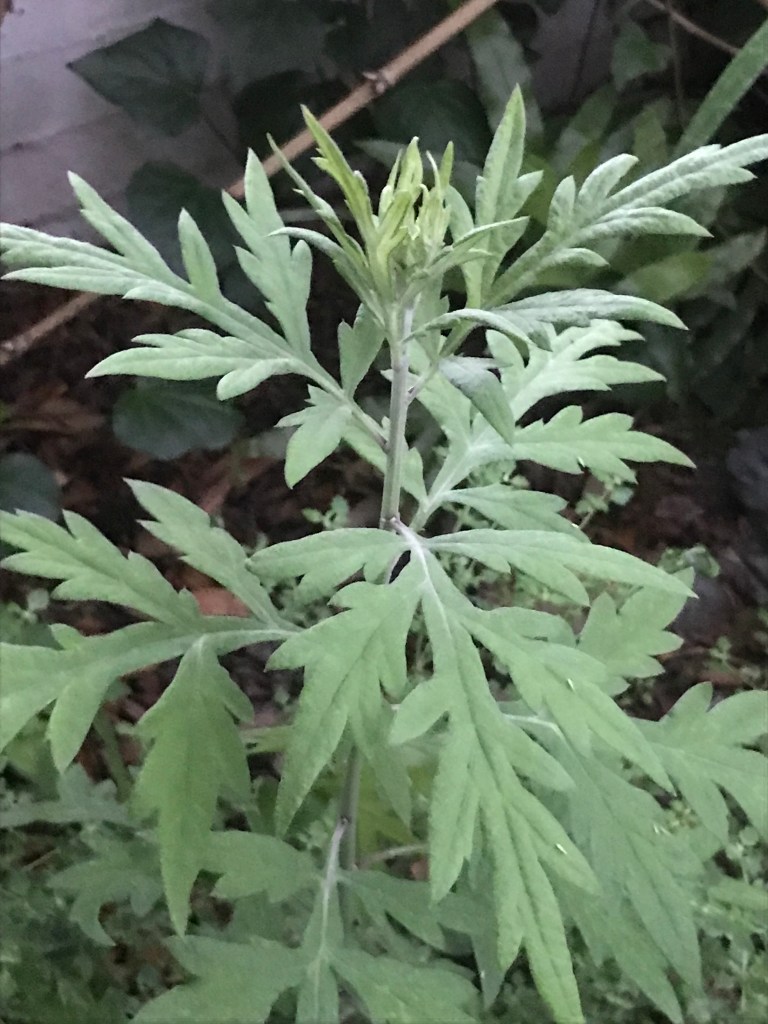
(Thats Mugwort growing in my garden).
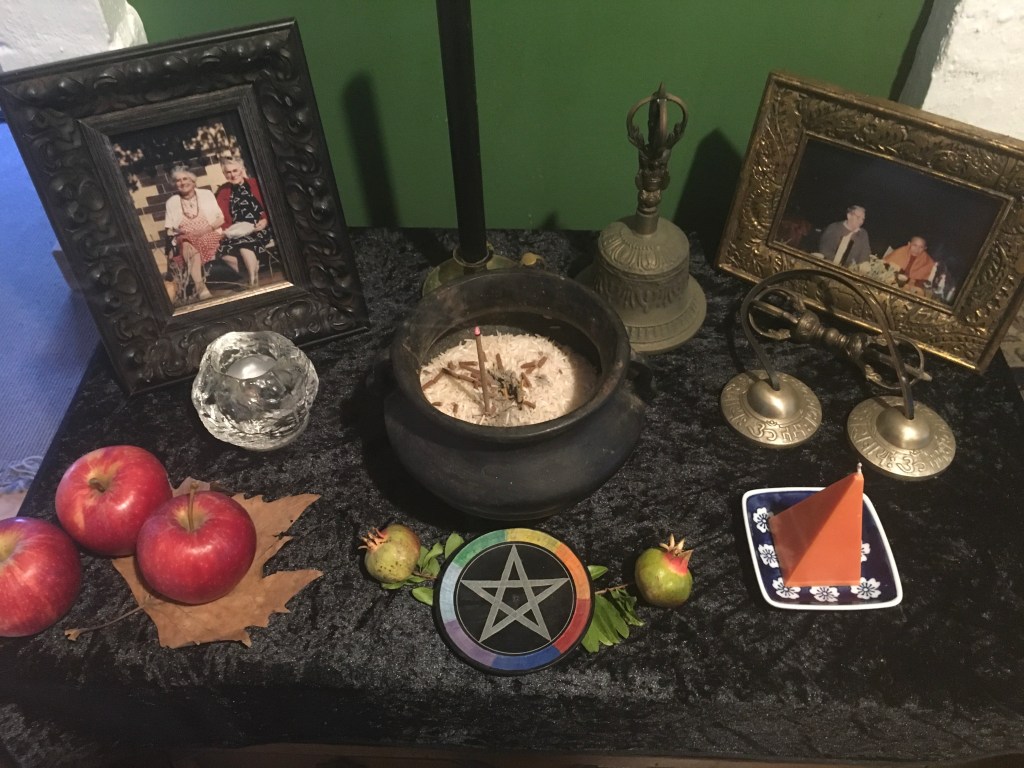
The Samhain Altar.
The colours of the Samhain altar are the colours of the season – Autumn. Black, dark purple and burgundy are reminders of night skies and sunsets. White, orange or yellow candles echo the stars in the night sky and the colours of leaves as they fall. However, a black altar cloth is most traditional. Place photographs or objects from people you have loved who are now in spirit on the altar; ancestors or friends or mentors. Also place symbols of death on the altar, as death is not to be feared. Use skulls, crystal skulls, skeletons and ghosts.
Place your tarot cards on the altar to be blessed, perhaps with the Death card showing. Also any other divination tools you may use, like runes or a black scrying mirror. Place food from the last harvest (pumpkins, apples, corn) as decorations and flowers or fallen leaves you may have collected. Pomegranates represent the goddess Hecate, and also Persephone’s time in the underworld, which are both honoured at this time.
Use dark coloured crystals like tourmaline, obsidian, jet and smoky quartz and burn earthy oils or incenses like frankincense, myrrh or patchouli. If you work with deities, put a statue or picture of a deity associated with death on the altar. Demeter, Hecate, Kali, Yama and Anubis are all associated with death in varying ways; study the myths of each to understand different cultures’ perspectives on death, the underworld, and rebirth.
Samhain Deities.
Demeter.
The myth of Demeter, the Greek goddess of corn, harvest, agriculture and country life, and her daughter Persephone explains the cyclic nature of the seasons and explains why we have Winter. Persephone is taken to the lower realm by Hades, god of the underworld – some accounts say she was taken by force and some say she went willingly as his bride. As she descends into the underworld with Hades her absence causes Winter on Earth as her mother Demeter rages and mourns the loss of her daughter. Demeter’s anger and grief causes the crops to fail and there is famine. If anyone eats food in the underworld (‘food of the dead’) they cannot return to earth, and Persephone had eaten 7 pomegranite seeds.
Zeus arranged a compromise to appease both Hades and Demeter, where Persephone could spend six months in the underworld and six months in the middle realm (the earth plane) and that is why the seasons are as they are. As Persephone returns to the earth she brings springtime with her and fertility and abundance is restored as the crops flourish once more. Demeter has become a symbol of Winter and death as her grief at the loss of her daughter caused the land to become barren.
Hecate.
According to Ari Kepach on the mythopedia website (2023), “the name Hecate… is the feminine form of hekatos, an epithet of the god Apollo meaning ‘the one who works from afar’. As an underworld goddess Hecate was chthonic (‘of the underworld’); as a goddess of magic and witchcraft she was nyktpolos (‘she who wanders at night’) or skylakagetis (‘leader of dogs’); as a goddess of crossroads she was trioditis (‘she of the triple road’); and in her capacity of helper to mortals she was soteira (‘saviour’), aldos (‘tender’), kourotrophos (‘nurse of the young’) or phosphoros (‘bringer of light’).”
“Hecate’s function… encompassed virtually every aspect of human life (and death). But the origins of this strange and mysterious goddess are unclear. Hecate probably originated as a Carian [modern day Turkey] goddess who was adapted by the Greeks…”
”Around 430 BCE, Hecate acquired her distinctive triplicate appearance. Artists began to represent the goddess as a female figure with three faces or three bodies. This iconography reflected Hecate’s role as goddess of the crossroads, with one face (or body) corresponding to each of the crossing roads, allowing Hecate to watch over each road simultaneously”.
“Hecate was most often identified by… a kind of cylindrical crown, and by torches… she was often accompanied by dogs”.
“Hecate’s other attributes and symbols included swords, polecats, red mullets, boughs, flowers and pomegranites. Some sources represented Hecate as the guardian of the gates of the underworld, or even as keeper of the keys of the underworld.”
“When Persephone was abducted… and spirited away to [Hades] gloomy underworld kingdom, Hecate was the only one who heard her cries. When Persephone’s mother Demeter was wandering the earth in search of her daughter, Hecate revealed what she had heard… Eventually Zeus forced Hades to restore Persephone to Demeter for at least part of the year [Spring and Summer]. The girl was at last reunited with her mother and with Hecate, who became her attendant and continued to receive great honours in the court of Demeter and Persephone (as a reward for helping Demeter’s search)”.
Kali.
Kali devours demons and their skulls are worn threaded into a necklace around her neck. Her skirt is made of severed arms and in one hand she holds a severed head. Like time, it is said she devours all things.
According to the world history encyclopedia website, “Kali is the Hindu goddess of death, time and doomsday. She is often associated with sexuality and violence but is also considered a strong mother figure and a symbol of motherly love. Kali embodies ‘shakti’ – feminine energy, creativity and fertility – and is an incarnation of Parvati, wife of the great Hindu god Shiva… Kali’s name derives from sanskrit meaning ‘she who is black’ or ‘she who is death’”.
Yama.
Geller (2016) asserts that Yama is a Hindu god and is believed to be the first human ever to die, setting a precedent for human mortality. “According to the vedas (ancient Hindu texts) there is a ‘Book Of Destiny’ where the records of each person’s lifetime deeds are recorded. It is Yama, the god of death, who determines the justice that each soul will receive, and their path after they die” (Geller, 2016). Yama determines if a soul goes to heaven or hell and what sort of rebirth a soul gets, which ties in with the Hindu caste system. Both karma and reincarnation are directly tied to the judgement of Yama. This idea is not unlike the more modern idea of the Akashic Records, as apparently accessed by both Rudolph Steiner and Edgar Cayce.
According to Wikipedia.org, “In the religion of theosophy and the philosophical school called anthroposophy the Akashic records are a compendium of all universal events, thoughts, words, emotions and intent ever to have occurred in the past, present or future in terms of all entities and life forms, not just human. They are believed by theosophists to be encoded in a non-physical plane of existence known as the mental plane”. Many in the New Age movement believe that each person receives a ‘life review’ from the Akashic records when they die, and also that these records can be accessed through meditation for useful information and guidance.
Anubis.
According to Joshua Mark, on the world history website, “Anubis is the Egyptian god of mummification, funerary rites, guardian of tombs, and guide to the afterlife…” He is thought to date back as far as 6000 BCE. Mark continues, “He is depicted as a black canine, a jackal-dog hybrid with pointed ears, or as a muscular man with the head of a jackal… Black symbolises the decay of the body as well as the fertile soil of the Nile river valley which represented regeneration and life… [He] was the protector of teh dead who made sure they received their due rights in burial and stood by them in the life after death to assist their resurrection… He was known as ‘First of the Westerners’ prior to the rise of Osiris… which meant he was king of the dead (as ‘Westerners’ was the Egyptian term for departed souls in the afterlife which lay westward, in the direction of sunset). In this role he was associated with eternal justice”.
“A popular image of Anubis”, states Mark, “is the standing or kneeling man with the jackals head holding the golden scales on which the heart of the soul was weighed against the white feather of truth. His daughter is Qebhet… who brings cool water to the souls of the dead in the hall of truth and comforts the newly deceased. Anubis’ association with Nepthys (known as ‘friend to the dead’) and Qebhet emphasises his long-standing role as protector of the dead and guide for the souls in the afterlife”.
REFERENCE LIST
Kepach, A., (March 10. 2023), Hecate [Website Article]. Retrieved from https://www.mythopedia.com
http://www.world history encyclopaedia.com/kali
Geller, Prof., (November 3, 2016), Yama [Website Article]. Retrieved from https://mythology.net/hindu/hindu-gods/yama
Mark, J., (25 July 2016), Anubis [Website Article]. Retrieved from https://www.worldhistory.org/Anubis
 The Witches of St. Kilda